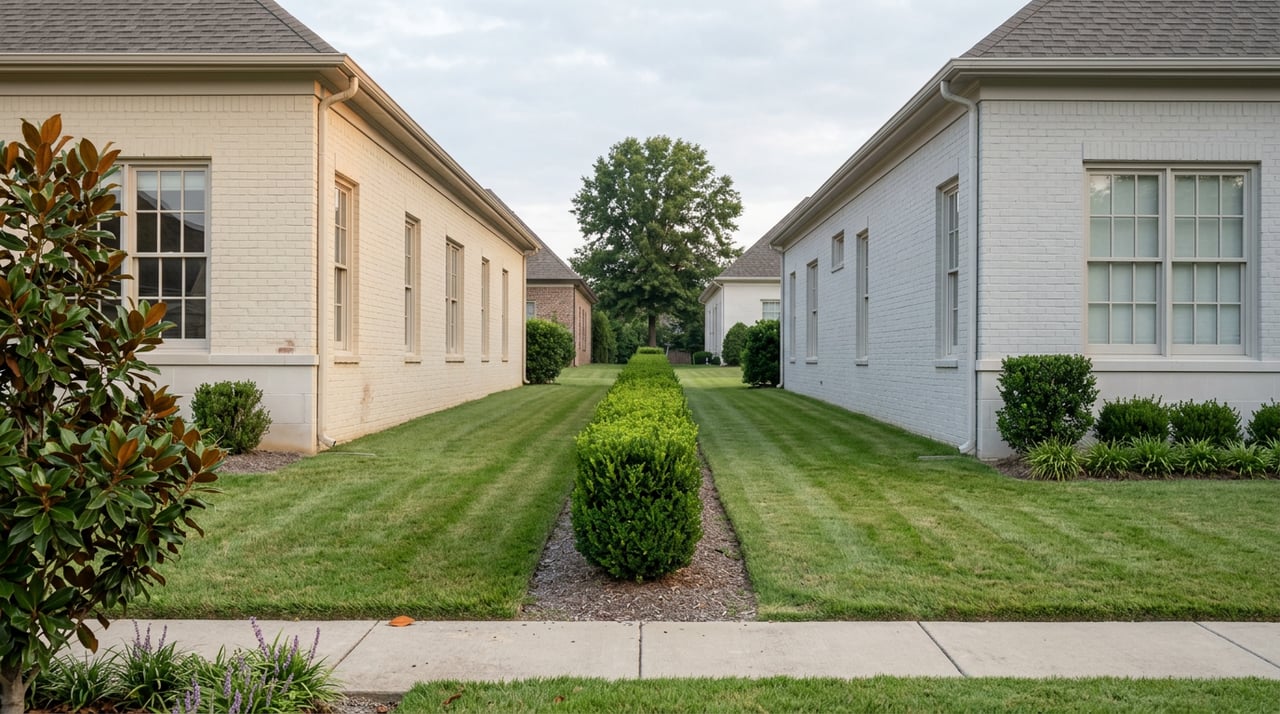
Canterbury has one entrance, one pool, one HOA newsletter, and a walking trail that loops the whole community without a single break in the pavement. From the street, it reads as one neighborhood. Pull the county map, and it isn't. Canterbury sits across the Williamson-Maury county line, which means two homes built by the same production builder, on the same street, with the same floorplan, can carry different property tax bills and sit in different school systems, depending on which side of a boundary that shows up on no sign and no fence they happen to occupy.
That's the situation every Spring Hill buyer walks into without being told. The city isn't one housing market wearing one zip code. It's two markets, governed by two counties, stitched together by a boundary most people never think to ask about until they're already comparing listings or, worse, already under contract.
One Median, Two Markets
Ask two of the most-cited home value trackers what Spring Hill is doing right now and you'll get two different answers. Redfin's rolling three-month window through May 2026 shows Spring Hill's median sale price at $542,000, up 5.3% from the same period a year earlier, with homes spending an average of 65 days on the market, a touch longer than the 63 days recorded a year prior. Zillow's home value index for roughly the same stretch of 2026 puts the typical Spring Hill home closer to $495,000, down about 5% year over year.
That's not a data glitch. It's a symptom. When you average two counties with different price floors, different tax structures, and different construction timelines into a single citywide number, the number stops describing a market and starts describing noise.
The more useful split comes from RealTracs MLS data covering the trailing 12 months reported in May 2026. Homes on the Williamson County side of Spring Hill carried a median sale price of $715,000. Homes on the Maury County side carried a median of $490,000. That's a 46% gap, and it isn't a fringe effect from a handful of outlier sales. Of 1,085 total closings in that period, 509 were in Williamson County and 576 were in Maury County, which means both sides of the line are doing real, comparable volumes of business. Layer on the fact that new construction across the city carried a median of $659,484 against $536,000 for resale, a roughly $123,000 gap on its own, and you can see how a single blended headline figure ends up hiding three separate variables at once: which county, which construction vintage, and which specific pocket of either county you're looking at.
The Rate That's the Same, and the Rate That Isn't
Here's where it gets counterintuitive. The piece of the tax bill you'd expect to differ, the city's own rate, doesn't. Spring Hill's official tax rate schedule sets the municipal rate at $0.739 per $100 of assessed value on both the Williamson and Maury County sides. That wasn't an accident of geography. In 2022, the city's Board of Mayor and Aldermen deliberately aligned the two rates through an amendment from Alderman Matt Fitterer, closing a gap that had existed for years so that the city's own slice of the bill would land the same no matter which county a resident's parcel sat in, a fact reported at the time by Williamson Scene.
What isn't aligned is the much larger piece layered underneath it: the county rate. JVM Lending reports Williamson County's rate at roughly $1.30 per $100 of assessed value and Maury County's at roughly $1.91 per $100, a real difference that shows up on every tax bill regardless of what the city does with its own number. The City of Spring Hill even collects and processes its portion separately from either county, which is a reminder that a Spring Hill homeowner is dealing with two distinct tax authorities from day one, not one blended system.
There's a second layer most buyers never see coming. The two counties are not on the same reassessment schedule. According to the City of Spring Hill's budget messaging, Williamson County's reassessment landed in the 2024-25 cycle, with Maury County's turn following in the cycle after that, so by the time a 2026 buyer is comparing two Spring Hill parcels, each side has already moved through its own reappraisal on its own timeline, not in lockstep. As of the city's most recent budget messaging, its own municipal rate had not been raised since 2019.
A tax rate quoted at closing is a snapshot. Whether it moves next year, and in which direction, depends on which county's reappraisal calendar your side of Spring Hill happens to be on.
What Each Side Actually Buys
The county line doesn't just move numbers around on a spreadsheet. It sorts the city's inventory into two distinct product types.
On the Williamson County side, buyers are typically shopping newer, larger-scale master-planned product: August Park, where builders including Toll Brothers and John Maher Homes are pricing from the upper $700s into the low $1 millions, along with the Preserve and Saddlewalk sections of the June Lake community, where new construction closed at $999,999 and $859,584 respectively in January 2026 alone. Established Williamson-side neighborhoods like Autumn Ridge, Cherry Grove, and Bluebird Hollow round out the resale side of that market. These parcels are zoned for Williamson County Schools, including Summit High School and Independence High School.
On the Maury County side, the price floor drops meaningfully. Harvest Point and Chapmans Retreat have been among the most active new construction communities, with Harvest Point closings in January 2026 ranging from $397,900 to $435,000, alongside established neighborhoods like Wyngate Estates. These parcels are zoned for Maury County Public Schools, including Spring Hill High School and Battle Creek High School.
Canterbury, again, is the community that makes the point hardest to ignore. Its pool, trails, and playground are identical no matter which side of the line a given lot sits on. Its tax bill and school zoning are not. That's the exact distinction a citywide median can never warn you about, because a median doesn't know which side of a boundary any individual sale happened on.
Before You Write an Offer
None of this shows up automatically on a listing sheet, a zip code, or an automated home value estimate, which typically pull comparable sales from the same zip code without separating them by county and can end up blending Williamson comps into a Maury County estimate or the reverse. Before you get attached to a specific Spring Hill address, it's worth building the county question into your process rather than assuming it out.
- Get the parcel ID from the listing, not the subdivision name. Subdivision names, mailing addresses, and zip codes don't reliably indicate which county a specific lot sits in, especially in communities like Canterbury that span both.
- Look up that parcel directly with the county assessor. Williamson County and Maury County each maintain their own property records, and the parcel number is what actually resolves the question.
- Confirm school zoning by address, separately from county confirmation. Builder marketing materials describe the community as a whole, not the individual parcel you're considering.
- Ask your lender to run carrying costs using the correct county rate before comparing two listings side by side. A monthly payment estimate built on the wrong county's tax rate will be wrong from the first month.
- Get county assignment in writing before removing contingencies, particularly in any community known to straddle the line.
A Few Questions Worth Settling Early
Does a 37174 zip code tell me which county I'm in? No. Both Williamson and Maury County neighborhoods in Spring Hill can share the same zip code, so the mailing address alone won't resolve it.
Is the property tax rate the same everywhere in Spring Hill? The city's own rate is equalized at $0.739 per $100 of assessed value on both sides. The county rate stacked on top of it is not, and that's the larger portion of the total bill.
Will an online home value estimate account for any of this? Not reliably. Automated valuations tend to draw comparable sales from the same zip code without separating Williamson County sales from Maury County sales, which can pull an estimate toward a number that doesn't reflect either side accurately.
The county line running through Spring Hill isn't a footnote to the market. For a meaningful share of the city's inventory, it's the reason two listings that look similar on paper end up worlds apart at the closing table. If you're weighing a specific Spring Hill address, whether it's new construction in August Park, resale value on the Maury County side, or a lot in a community like Canterbury where the line runs straight through the middle, that's exactly the kind of parcel-level due diligence Susan Gregory and her team walk buyers through before an offer goes in, not after. If you'd like a second set of eyes on a specific property or neighborhood, reach out to request a consultation.
This article is general information, not legal, tax or financial advice. Consult a qualified professional about your situation.